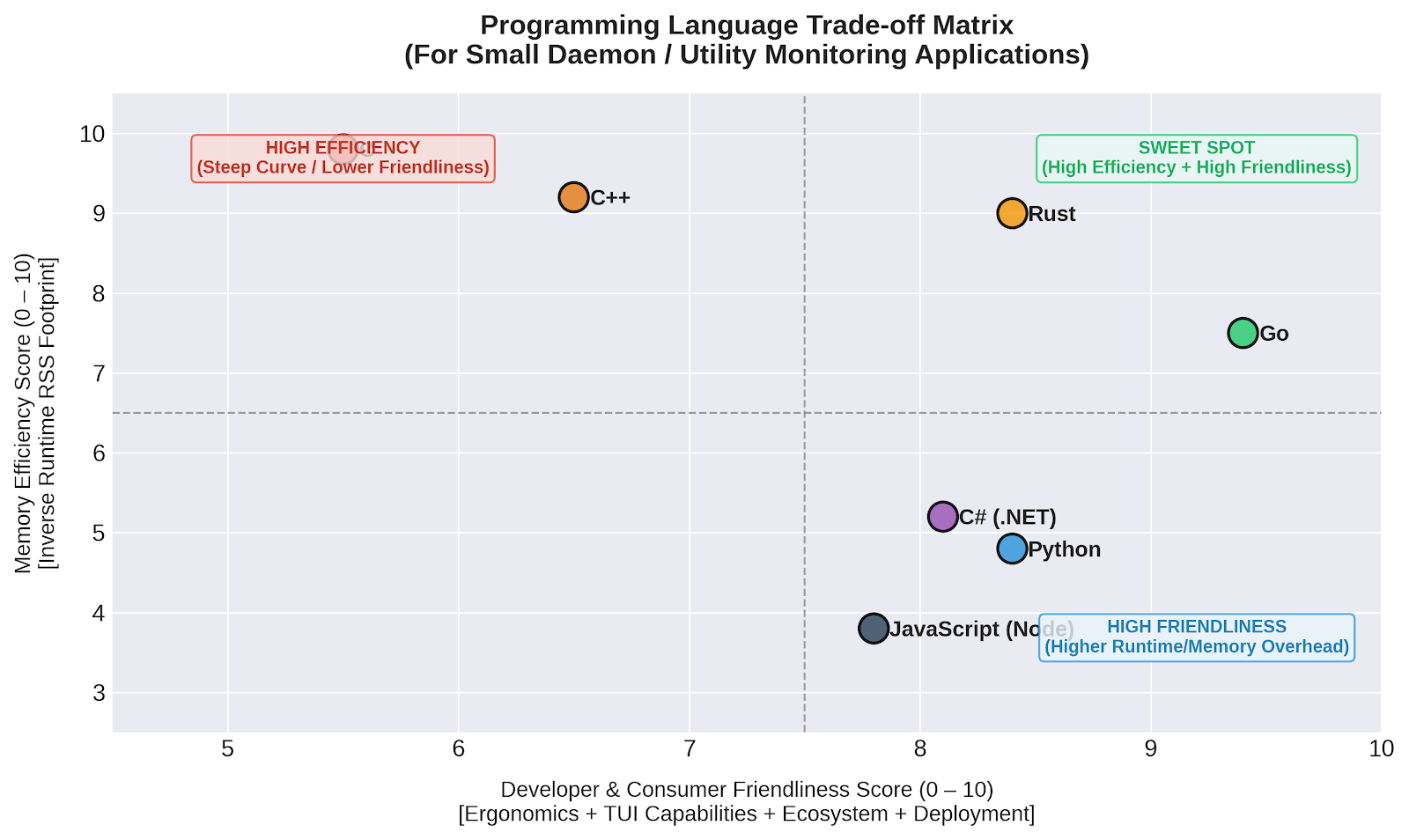
Here I evaluate where each language sits on the spectrum between hardware resource consumption and user/developer ergonomics.
I standardized the scoring through a 10-point rubric.
1. Scoring Rubric Breakdown
Y-Axis: Memory Efficiency Score (0 – 10)
Calculated directly from typical runtime Resident Set Size (RSS) footprint for a lightweight daemon/utility:
- 9.0 – 10.0: Ultra-low footprint (< 5 MB). No Garbage Collector or VM overhead.
- 7.0 – 8.5: Low footprint (10 – 25 MB). Minimal GC runtime pre-allocation.
- 4.5 – 6.0: Moderate footprint (30 – 50 MB). VM/Interpreter baseline or JIT allocations.
- < 4.0: High footprint (> 50 MB). Heavy runtime context pre-allocation (e.g., V8 engine).
X-Axis: Developer & Consumer Friendliness Score (0 – 10)
A composite score across four core usability categories (each weighted up to 2.5 points):
- Developer Ergonomics (2.5 pts): Low Syntax Entropy, memory safety, compile speed, and low Refactor Distance.
- TUI & Display Readability (2.5 pts): Availability of declarative terminal UI frameworks (e.g.,
bubbletea,ratatui,rich,Spectre.Console). - Ecosystem & Stdlib (2.5 pts): Built-in string parsing, file I/O, and concurrency primitives out of the box.
- Deployment Simplicity (2.5 pts): Convenience for the consumer (e.g., single self-contained static binary vs. requiring installed runtime dependencies).
2. Evaluation Matrix
The following reflects personal scoring:
| Language | Dev Ergonomics (2.5) | TUI & Display (2.5) | Ecosystem (2.5) | Deployment (2.5) | Friendliness (X-Axis) | Memory Efficiency (Y-Axis) |
|---|---|---|---|---|---|---|
| Go | 2.3 | 2.3 | 2.3 | 2.5 | 9.4 | 7.5 |
| Rust | 1.6 | 2.2 | 2.2 | 2.4 | 8.4 | 9.0 |
| Python | 2.5 | 2.4 | 2.5 | 1.0 | 8.4 | 4.8 |
| C# (.NET) | 2.2 | 1.9 | 2.2 | 1.8 | 8.1 | 5.2 |
| JavaScript (Node) | 2.0 | 2.1 | 2.5 | 1.2 | 7.8 | 3.8 |
| C++ | 1.0 | 1.5 | 1.8 | 2.2 | 6.5 | 9.2 |
| C | 0.6 | 1.2 | 1.5 | 2.2 | 5.5 | 9.8 |
3. Visual Trade-off Matrix
The generated scatter plot illustrates three distinct quadrants:
-
🟢 The Sweet Spot (Top Right) Go and Rust dominate here.
- Go achieves the highest overall friendliness score (9.4) because it combines fast developer velocity with static single-binary distribution (
go build) while maintaining a tight 10–15 MB memory footprint.
- Go achieves the highest overall friendliness score (9.4) because it combines fast developer velocity with static single-binary distribution (
-
🟡 High Efficiency / Low Ergonomics (Top Left) C and C++ yield near-zero memory footprint, but drop in overall friendliness due to complex build systems, lack of unified package management, and manual memory handling for basic string tokenization.
-
🔴 High Ergonomics / High Runtime Cost (Bottom Right) Python, C#, and Node.js excel in rapid prototyping and rich UI abstractions (e.g., Python’s
Textual), but pay a fixed tax in runtime memory footprint (30–80 MB) and deployment friction (runtime environments or large bundled runtimes).